
Protect Our Dunes. Get Reimbursed.
Installing sand fencing or planting American beach grass helps protect our coastline. Learn who qualifies, what work is allowed, how much you may receive, and how to apply—all in one place.

Choose Your Dune Protection Project
Year-round
Sand Fence Reimbursement
Up to $500
Per 100 linear feet of oceanfront property, based on actual eligible paid costs.
Frequency: One reimbursement per calendar year (January–December), per the program guidance supplied for this page.
November 1 – March 31
Dune Vegetation Reimbursement
Up to $400
Per 100 linear feet of oceanfront property, based on actual eligible paid costs for American beach grass.
Frequency: One reimbursement per planting period, per the program guidance supplied for this page.
Reimbursement is not an automatic flat payment. Eligible paid costs, inspection, approval and available program funds apply. Requests above the stated maximum may be considered at the discretion of the County Manager or Planning & Inspections Director.
Important: This is a reimbursement program. Complete and pay for eligible work, keep itemized paid receipts to submit with the required application and W-9. County grant agreement and inspection requirements also apply. Contact staff before beginning if you need to confirm your site or installation requirements.
Who Can Apply?
- Oceanfront Homeowners Associations (HOAs) and Property Owners Associations (POAs).
- Individual owners of property with a frontal dune where an HOA/POA is not participating or no association exists.
- Projects must be on an eligible frontal dune and meet County and applicable coastal rules.
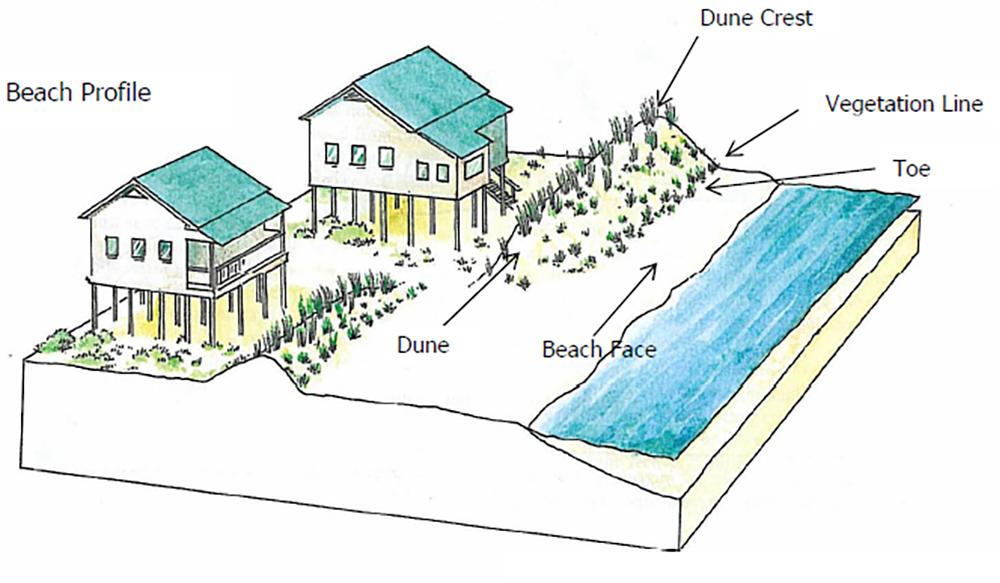
Sand Fence Installation Instructions
Applicable rule: 15A NCAC 07K .0212, Installation and Maintenance of Sand Fencing. Fencing meeting all the rule’s criteria is exempt from CAMA permit requirements; other work may require permits.
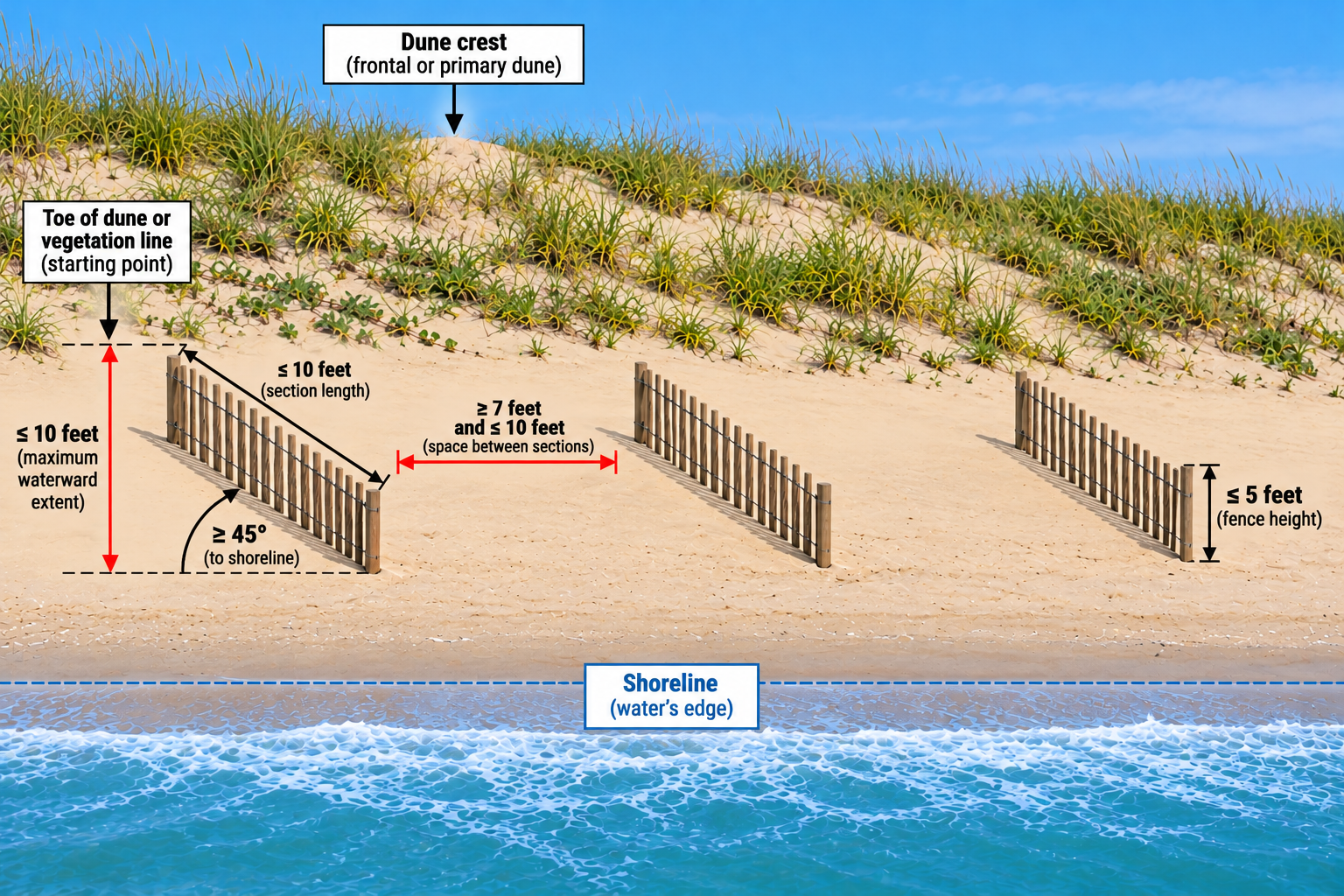
Fence construction
- Wooden vertical slats approximately 1–1½ inches wide, evenly spaced and joined by twisted wire.
- Maximum fence height: 5 feet.
- Wooden supports no larger than 2 × 4 inches or 3 inches in diameter.
Angled sections waterward of dune crest
- Angle: at least 45° to the shoreline.
- Each section: no more than 10 feet long.
- Between sections: at least 7 feet.
- Extent: no more than 10 feet waterward of the most waterward applicable reference feature.
Where fencing can—and cannot—go
- Place fencing as far landward as possible; never on the wet-sand beach.
- Shoreline-parallel fencing must not be waterward of the frontal or primary dune crest.
- For angled fencing waterward of the crest, measure the 10-foot limit from whichever is most waterward: first line of stable natural vegetation, toe of the frontal/primary dune, or erosion escarpment, as defined by state rules.
- Do not block beach access, recreation, public trust rights or emergency vehicles.
- Do not trap, impede or endanger sea turtles, nests or hatchlings.
- Fencing along public accessways may run the accessway’s length and have a 45° waterward funnel, but its waterward end must meet the same 10-foot limit.
- Owners must remove non-functioning, damaged or unsecured fencing upon discovery.
Purpose matters: Sand fences are for trapping windblown sand to build dunes or protecting dunes and vegetation—not for closing off public beach access.
Dune Vegetation: How to Plant Beach Grass
Reimbursement window: November 1 – March 31
Plant American beach grass (Ammophila breviligulata) to help stabilize sand. The cool season, November through March, is the preferred planting period.
Planting specifications
- Species: American beach grass; the “Cape” variety may be recommended.
- Depth: Plant culms or plugs approximately 8–10 inches deep.
- Spacing: 18–24 inches apart in a staggered pattern.
- Per hole: Use a shovel or dibble and place 2–3 culms (stems).
Location and care
- Plant on suitable ocean-facing foredune and back-beach dune areas to capture blowing sand.
- Avoid steep, actively eroding slopes where possible.
- Do not fertilize at the time of planting. American beachgrass should only be fertilized once its root system begins to establish, which typically occurs during March or April of its first spring following winter installation.
How to Get Reimbursed
- Confirm eligibility and the current program window. Check whether your HOA/POA is participating. Vegetation applications are seasonal.
- Plan the project correctly. Follow sand fence state rules or the County’s beach grass specifications. Ask staff about permits or site questions.
- Complete and pay for the work. Save itemized paid receipts for eligible materials, installation and any eligible fertilization.
- Submit the online application. Select sand fencing, dune vegetation, or both (for both, apply after November 1 and after the eligible work is completed). Include receipts and required W-9.
- County inspection. After receiving your application, paid receipts and W-9, County staff will schedule an inspection and photograph the completed installation. You do not need to schedule or attend the inspection.
- Receive and sign the grant agreement. After your application and receipts are received and the County inspection is completed, the County will contact you by email with the grant agreement for your signature. Approved reimbursements are processed following satisfactory review and completion of the required paperwork.
Frequently Asked Questions
-
Can I apply for both programs at once?
Yes. Complete and pay for both eligible projects, then after November 1 select both programs on the online application and upload receipts and the W-9. Each program has its own reimbursement rules and limits.
-
When can I apply
Sand fencing operates year-round, with one reimbursement per calendar year (January–December). Dune vegetation reimbursement runs November 1–March 31, with one reimbursement per planting period. Confirm annual funding and deadlines with County staff.
-
Do I need a CAMA permit for sand fencing?
Fencing that fully complies with 15A NCAC 07K .0212 is exempt from CAMA permit requirements. If the design does not comply or the project involves other coastal work, consult the County’s CAMA permit staff.
-
Who arranges the installation?
The property owner or participating association arranges the purchase and installation and retains paid receipts to submit with their application.